
CNRS - Imperial PhD joint programme – 2026 Call for projects: Quantitative Science and Engineering for a Sustainable World
Imperial and the Centre National de la Recherche Scientifique (CNRS) recognise that collaborative international activities enable cross-border pooling of research capabilities and sharing of expertise and facilities, the opportunity to appreciate different perspectives, outputs that are typically more highly cited, as well as access to new environments for impact and exploitation of research outcomes.
CNRS and Imperial are launching a seventh joint call for collaborative PhD proposals between the two institutions. The theme for this year is “Quantitative Science and Engineering for a Sustainable World”.
Particular emphasis will be placed on projects contributing towards addressing SDG-related challenges such as watercycle and the energy transition, using mathematical and/or engineering approaches.
Examples of research themes include, but are not limited to:
- Future technologies.
- Transport of people and ideas.
- Resilience and risk mitigation.
- Systems approach to support the built and natural environment.
The aim of this Call is to develop collaborative PhD projects that can train and network the next generation of researchers and innovators, offering them expertise not available at just one institution, and to also seed Imperial-CNRS collaborations that can lead to Horizon Europe and other funding opportunities.
Imperial and CNRS now have 30 collaborative projects and 60 PhD students registered with the collaborative PhD programme, working on high-impact UK-France projects.
This call invites Principal Investigators at CNRS and Imperial to jointly put forward a research project to be underpinned by x1 PhD at CNRS and x1 PhD at Imperial, which includes joint supervision plans and a built-in mobility programme. Support for CNRS-Imperial cohort-building activities and relevant training will also be provided each year.
Strategic rationale
CNRS is Europe’s largest fundamental science research organisation and have 1,100 research labs in France and abroad; a budget of 4.2bn Euros; 33,000 staff dedicated to research. Imperial and CNRS researchers have co-authored 2,919 publications in the past five years (2020-2025) and have 31 collaborations thus far in Horizon Europe.
The CNRS-Imperial International Research Centre (IRC) for Transformational Science and Technology, launched in April 2022, is deepening and expanding connections between our two institutions to address UN Sustainable Development Goals.
Formal collaborations under the IRC umbrella are:
- International Research Lab Abraham de Moivre (Mathematics)
- International Research Lab Ayrton Bleriot Engineering Lab.
- International Research Project Integrative Metabolism.
- International Research Network Quantum Fields and Strings
- International Research Network GOLDMINE (neuromorphic sustainable computing).
- International Research Network LhARA (physics for medicine/novel laser treatment for cancer).
- Joint PhD programme
The €95.5 billion Horizon Europe budget, which runs from 2021-2027, provides continued impetus for joint scientific discovery and innovation.
Call guidelines
Eligibility
- Scientists from Imperial who can supervise PhD students;
- Scientists working in a research lab affiliated to CNRS holding an accreditation to supervise PhD students (HDR)
- A PI cannot submit more than one application in the framework of this call.
There must be one PI from Imperial and one PI from a CNRS laboratory. Those who do not already have a collaborator may consult Imperial’s website or the CNRS website to find information on the research groups and projects being carried out in either institution and/or contact the IRO at Imperial or DEI at CNRS for support in identifying potential collaborators.
Funding
The model is for each collaborative project to have two PhD students and two supervisors, one of each at both Imperial and CNRS.
At CNRS the funding will be for a three-year studentship. Funds will include mobility costs for visits to London for the project over three years.
At Imperial, 50% of the funding for the three-year studentship (Home fee + UKRI London stipend) is allocated centrally, and additional funding of £2500 is provided for mobility. The remaining 50% of the studentship must be allocated by the Imperial PI’s department or other funder (eg CDTs, DTPs, or other research groups, external funding). If a PI has more than 50% of the funding to contribute, then anything not needed for the studentship can be used for additional mobility, consumables, or other related costs to support the project. Given that 50% co-investment is required to apply, Imperial applicants must submit confirmation (an email is sufficient) of funding for 50% of a studentship from the person who is responsible for the funding source of the studentship e.g if using a department studentship allocation then submit a note from the HoD or similar, if using a CDT studentship then submit a note from the Imperial CDT lead, if industry funding, a note from the relevant person at Imperial or the industry partner, etc.
Number of awards
Up to four projects are expected to be funded jointly by Imperial and CNRS.
Support period
3 years
Deadline and start dates
Open date: 8 December 2025
Closing date: 23 January 2026
Notification date: March 2026
Beginning of the projects: October 2026
Evaluation
Proposals will be evaluated and ranked by an Imperial-CNRS committee according to the following criteria:
- Does the proposal clearly engage with the call topic for this year.
- Scientific quality & originality of the project
- Scientific merit of the teams
- Synergy between the teams, added value of international cooperation
- Convincing plan for engaging PhD students in the research and for managing joint supervision
- Projects are likely to be sustainable beyond the grant period. (The proposals should also include an outlined plan for raising external competitive funding.)
- Benefit to researcher based on her/his career stage
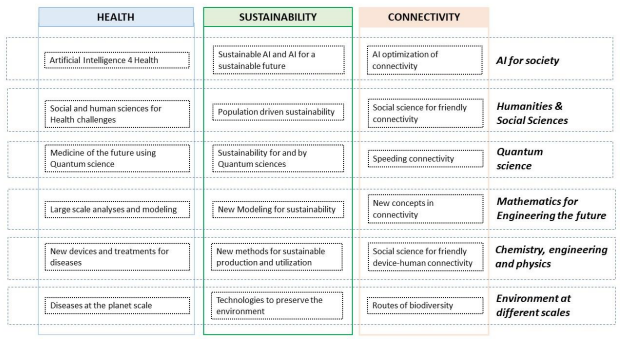
For additional context, the focus areas of the IRC are identified in the below chart.
How to apply
Imperial applicants should submit in electronic format (Microsoft Word or Adobe PDF) to globalseedfunds@imperial.ac.uk;
CNRS applicants should submit the same file via the dedicated platform: https://noa.cnrs.fr/#/accueil (as several PhD Joint Programs are currently open for proposals, please make sure you select the correct call).
Administrative and technical support
Imperial IRO: Ms. Heather S. Kerst, h.kerst@imperial.ac.uk
CNRS DEI: Mr. Carl Ialamov, carl.ialamov@cnrs.fr